


Using Threat Modeling to Put VAPT Results into Context
Every Vulnerability Assessment and Penetration Testing (VAPT) exercise produces a familiar output: a list of findings, severity ratings, affected assets, and remediation recommendations. Yet many security teams still struggle to answer a simple question:
Which vulnerabilities should we fix first?
The problem is that vulnerabilities do not exist in isolation. Attackers rarely achieve their objectives through a single vulnerability. Instead, they chain together multiple weaknesses, move across systems, escalate privileges, and exploit trust relationships within an environment.
This is where threat modeling provides value.
The Limitation of Traditional VAPT Reports
A typical VAPT report might identify findings such as:
- An exposed management interface
- Weak authentication controls
- Missing security patches
- Excessive user privileges
- Insecure API configurations
Each finding is assigned a severity score, often based on technical characteristics such as exploitability and impact. However, these scores do not always reflect the actual risk to the organization.
For example, two “Medium” vulnerabilities may individually appear unimportant. But when combined, they may enable an attacker to gain administrative access to a critical system. Conversely, a “High” severity vulnerability may exist on a system that is isolated from sensitive assets and therefore poses limited practical risk.
In other words, VAPT tells us what weaknesses exist. But threat modeling helps us understand how those weaknesses can be exploited in practice.
Connecting Findings Through Attack Paths
Threat modeling focuses on identifying attacker objectives, attack surfaces, trust boundaries, and system interactions. When VAPT findings are incorporated into a threat model, individual vulnerabilities become building blocks of larger attack scenarios.
Consider a healthcare system:
- An attacker establishes a rogue access point in the wireless hospital network.
- A vulnerability in a body monitor device allows the attacker to connect to it.
- The attacker compromises the body monitor and moves laterally in the network to the device gateway.
- A weakness in authentication protocols enables the attacker to send control commands from the gateway to the infusion pump.
- The infusion pump overdelivers or underdelivers medication to the patient.
Viewed individually, each finding may appear manageable. Viewed together, they form a complete attack path leading to a critical business impact: compromise of patient’s safety, resulting in potential death. Threat modeling reveals these relationships and exposes the routes an attacker is most likely to take.
From Vulnerability Lists to Risk-Based Prioritization
One of the biggest challenges after a VAPT exercise is remediation prioritization. Security teams often face constraints such as:
- Limited engineering resources
- Maintenance windows
- Operational dependencies
- Competing business priorities
Without context, remediation decisions are often driven by severity scores alone. Threat modeling enables a different approach. Instead of asking:
Which vulnerabilities have the highest CVSS score?
Organizations can ask:
Which vulnerabilities appear most frequently in high-risk attack paths?
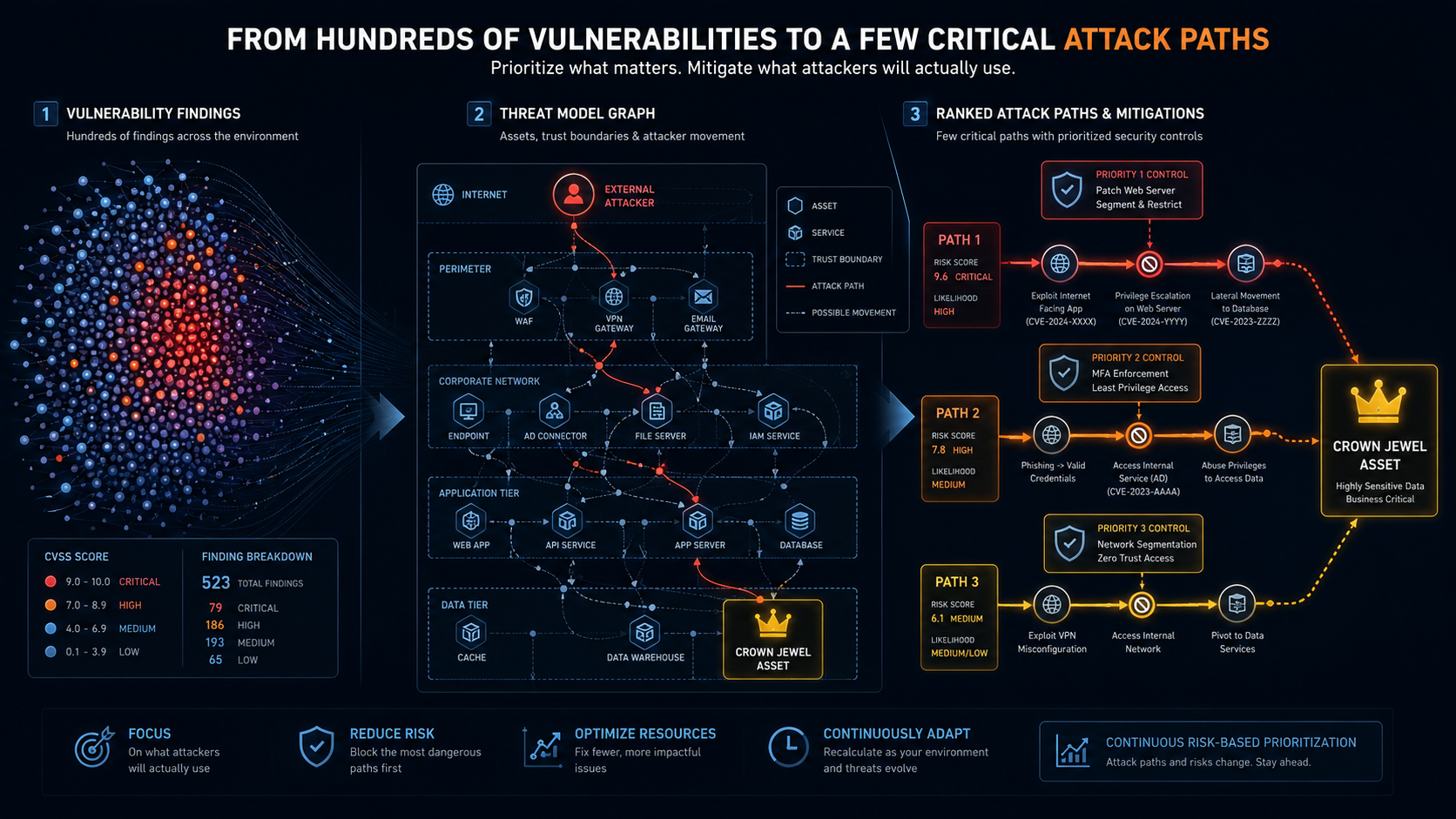
This shifts remediation from vulnerability-centric thinking to attack-centric thinking. A single control may disrupt multiple attack paths simultaneously, producing a much greater reduction in risk than addressing isolated findings.
Continuous Threat Modeling with ThreatMirror
Threats evolve, systems change, and new vulnerabilities emerge. A threat model should therefore not be treated as a one-time exercise. As new VAPT findings become available, they can be continuously incorporated into the threat model:
- New vulnerabilities are mapped to system components.
- Existing attack paths are updated.
- New attack paths are generated.
- Security control effectiveness is reassessed.
- Remediation priorities are recalculated.
In ThreatMirror, we can ingest VAPT results (or run VAPT tools directly) to determine the most critical, high-fidelity attack paths that leverage the vulnerabilities found by those VAPT tools. The remediations suggested by those tools will also be ranked so that security teams can determine which fix to apply first. This transforms threat modeling from a static documentation exercise into a living representation of organizational risk.
Conclusion
VAPT reports are invaluable for identifying weaknesses, but they often lack the context needed for effective decision-making. Threat modeling bridges this gap by showing how vulnerabilities interact, how attackers can chain them together, and which attack paths lead to the most significant business impacts. By combining VAPT findings with threat modeling, organizations can move beyond vulnerability management and toward risk-driven security engineering—prioritizing the fixes and controls that matter most.