


Threat Modeling & Cybersecurity Assurance Workshop
Earlier this week, we had the pleasure of co-hosting a workshop with Critical Systems Lab, focusing on an emerging and important area at the intersection of cybersecurity and safety assurance.
Why This Topic Matters
As critical decision systems like water treatment facilities, hospital systems, and airport traffic control systems become increasingly connected and complex, ensuring both their safety and security is more critical than ever. Traditionally, safety and cybersecurity have been treated as distinct domains—each with its own frameworks, tools, and assurance methods. However, the growing overlap between safety and security risks highlights the need for integrated approaches that can capture dependencies and interactions between the two. This is especially true when AI is integrated into the mix as a way to increase the efficacy of the decision-making process.
Workshop Focus
The session provided an opportunity to explore how cybersecurity threat modeling can be integrated into safety assurance cases, and to exchange ideas on the potential value of developing automated tools to support this integration.
Our discussion centered around:
-
How threat modeling techniques can inform and strengthen safety argumentation frameworks.
-
The challenges of aligning differing terminologies, objectives, and evidence structures across the safety and security domains.
-
The potential role of automation in improving consistency, traceability, and scalability in assurance case development.
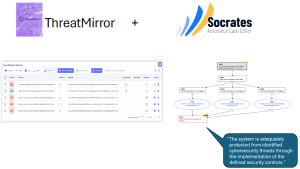
We provided a case study of a hospital system where AI is integrated into the Internet of Medical Things (IoMT) in order to provide more finely controlled dosages to a patient. Participants played with ThreatMirror to build threat models automatically from system architecture diagram inputs. Later, in the afternoon session, they experimented with using the threats and suggested mitigations by ThreatMirror in building a cybersecurity assurance case with Socrates, a tool offered by Critical Systems Lab.
Key Takeaways
A few themes emerged from the workshop discussions:
-
Common foundations – Many of the reasoning principles used in safety assurance can be adapted to support cybersecurity arguments, providing a common basis for integrated assurance.
-
Tool support is essential – Automated or semi-automated tools can play a key role in streamlining thought processes and bridging gaps between safety and security models, reducing duplication of effort.
-
Collaboration matters – Progress in this area requires sustained collaboration between domain experts, researchers, and practitioners.
Looking Ahead
This workshop marked a valuable step in an ongoing conversation about how to better align safety and cybersecurity practices. OverArX and Critical Systems Lab plan to continue exploring these intersections and developing methods that can make integrated assurance more practical and scalable.